
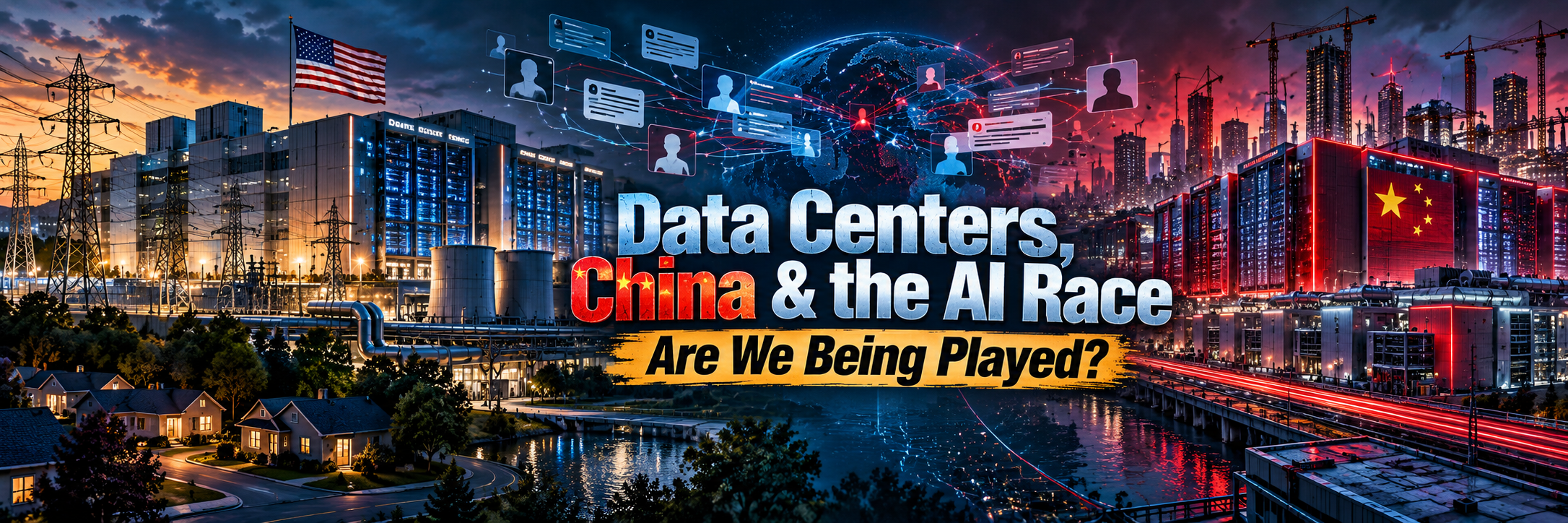

Apparently, data centers are the new thing we’re all supposed to argue about.
They use too much electricity. They use too much water. They’re ugly. They’re noisy. They’ll raise your electric bill. They’ll destroy the planet. They’ll save the economy. They’ll bring jobs. They won’t bring enough jobs.
Basically, give the Internet five minutes and it can turn a large building full of computers into the next national emergency.
But lately there’s another question being thrown into the mix:
Is China helping fuel some of the backlash against data centers in the United States?
And surprisingly, the answer isn’t simply “that’s crazy.”
But it also isn’t “everybody complaining about a data center is secretly working for Beijing.”
As usual, reality has decided to be inconvenient.
Yes, There Really Has Been Chinese Influence Activity
In June, OpenAI reported shutting down accounts connected to what it described as a likely China-based influence operation.
The accounts were being used to create social media posts criticizing American AI infrastructure and data centers. Some of the content was specifically written to sound like it came from ordinary Americans concerned about electricity prices and local communities.
So yes, that actually happened.
Before anyone starts checking underneath their neighbor’s porch for Chinese spies, though, there’s an important second half to the story.
Researchers looking at the activity found very little evidence that these accounts were responsible for creating the larger opposition to data centers. The concerns were already here. The foreign activity appears to have been trying to amplify an argument Americans were already having, not invent one from scratch.
Which, when you think about it, makes a lot more sense.
If you wanted to divide people, why invent a brand-new argument when we already have perfectly good ones lying around?
We’re Americans. We manufacture arguments domestically just fine.
The Concerns Aren’t Fake
This is the part that shouldn’t get lost.
There are legitimate concerns about giant data centers.
They require enormous amounts of electricity. Some use significant amounts of water for cooling. They can require new power infrastructure, and communities have reasonable questions about who pays for that infrastructure and whether local electric customers eventually get stuck with part of the bill.
The growth is also happening very quickly. The International Energy Agency expects data-center electricity use to increase dramatically through the end of the decade, with the United States and China accounting for most of that growth.
So asking questions about where these things are built and how they're powered isn't anti-technology.
It’s common sense.
If somebody wants to build a gigantic facility next to your town that consumes enough electricity to make your toaster look environmentally responsible, you’re allowed to ask a few questions.
But Then There’s China
Here’s where things get more interesting.
While Americans debate whether another data center should be built down the road, China isn’t exactly sitting around wondering whether artificial intelligence is going to matter.
China and the United States are already the two biggest data-center markets in the world, and both countries are pouring resources into AI infrastructure.
The U.S. intelligence community describes China as America's most capable competitor in artificial intelligence and says China wants to become the global AI leader by 2030.
That doesn't mean we should approve every data center somebody wants to build.
It does mean there's a bigger picture worth thinking about.
AI requires computers.
Lots of computers.
Those computers require data centers.
Those data centers require electricity.
Unfortunately, nobody has yet figured out how to operate several thousand GPUs using positive thoughts and a motivational poster.
Is This Actually a Race?
I think this is the real question.
We hear constantly about the AI race between the United States and China.
If AI really becomes as important as many people believe it will—affecting medicine, manufacturing, communications, cybersecurity, science, defense and basically everything else—then the infrastructure behind it matters too.
You can't claim you want to lead in AI while making it nearly impossible to build the infrastructure AI requires.
At the same time, “we have to beat China” shouldn't become a magic phrase that means technology companies get to build whatever they want, wherever they want, and everybody else should shut up and enjoy the privilege of paying the electric bill.
There has to be something between those two positions.
At least I hope there is.
Maybe That's the Part We Should Be Paying Attention To
The Chinese influence angle interests me less because I think China somehow created America's data-center opposition and more because it shows how easy this kind of thing can be.
You don't necessarily have to convince people of something completely false.
You find something they're already worried about.
You make the problem sound a little worse.
You make the other side sound a little more evil.
You encourage everyone to scream at each other.
Then you sit back and watch.
That's considerably easier than inventing an argument from nothing.
And to be fair, we seem perfectly capable of doing most of that without outside assistance.
So... Should We Build Them?
I don't think the answer should be blindly yes or blindly no.
Communities should absolutely ask questions about electricity, water, infrastructure, noise, land use and who is paying for everything.
Technology companies should have to answer those questions.
But we should probably also be careful about reaching the point where every proposal becomes:
DATA CENTER BAD. STOP IT.
Because while we're arguing about whether artificial intelligence should have somewhere to live, the rest of the world isn't necessarily waiting for us to finish the argument.
China certainly isn't.
Maybe the real challenge isn't choosing between building data centers everywhere or building none at all.
Maybe it's figuring out how to build the infrastructure we're going to need without screwing over the communities where we put it.
And maybe, once in a while, before sharing that perfectly rage-inducing Facebook post explaining how a data center is going to drain the town reservoir, double your electric bill and personally kick your dog...
...we should at least wonder who really wants us angry.
Because these days, that might be the most important question on the Internet.
