
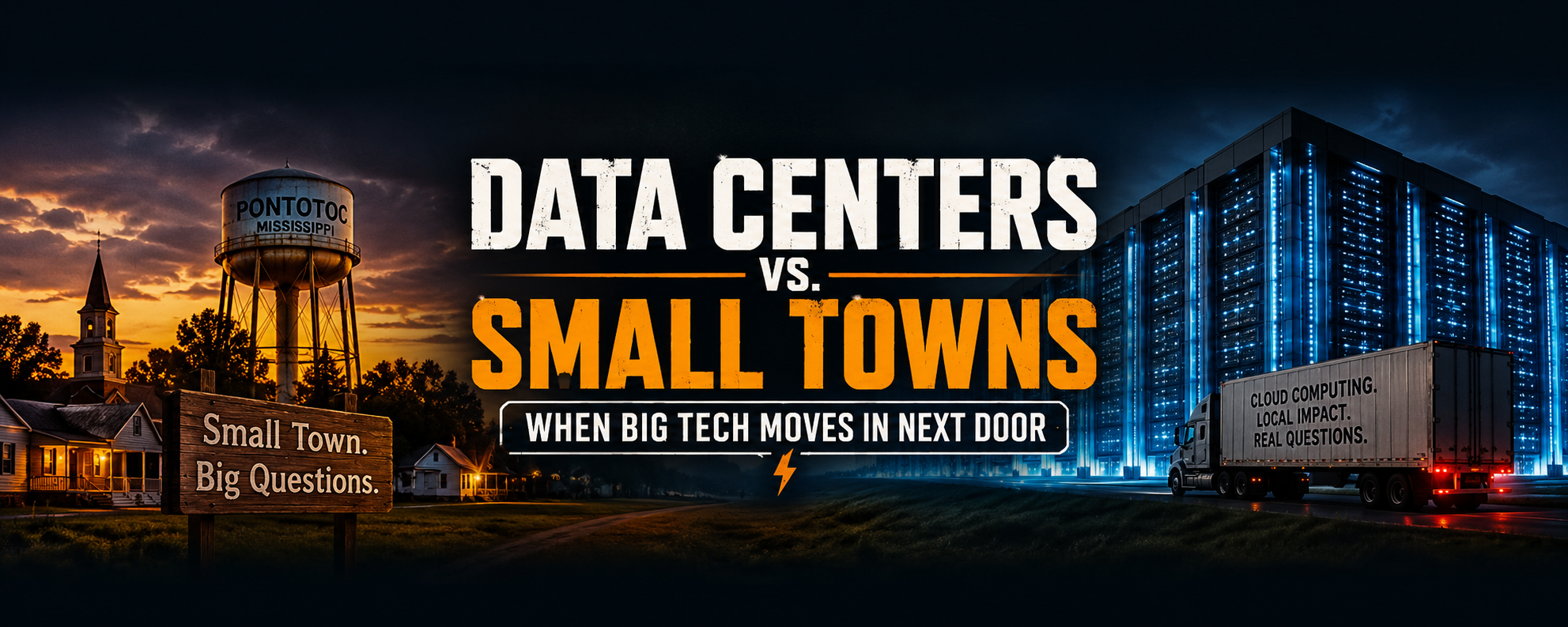

There was a time when small-town development meant a new grocery store, a factory, a truck stop, maybe a Dollar General if the town was really moving up in the world.
Now apparently we are in the era where “economic development” might mean a giant data center planted in the middle of rural land so artificial intelligence can keep answering questions like, “Write me a professional email, but make it sound less like I hate everyone.”
Progress is beautiful.
Lately, the rumor floating around near me is that Pontotoc, Mississippi could possibly become home to a data center. Now, before everybody starts buying hard hats and naming their Wi-Fi network “Skynet Local Branch,” let’s be clear: I have not found proof that a major tech company has officially announced a data center in Pontotoc.
What does exist is a real listing for a large piece of property on Goodfood Road in Pontotoc County being marketed as data center land. The listing describes around 500 acres, mentions hyperscale and AI uses, TVA power territory, fiber on-site, municipal water, and other things that make developers start sweating into their Patagonia vests.
So no, this does not mean Amazon, Google, Meta, Microsoft, xAI, or the ghost of Clippy has definitely signed the paperwork and ordered the concrete trucks.
But it does mean someone looked at rural Mississippi and said, “You know what this peaceful area needs? A massive box full of servers eating electricity like a teenager eats pizza rolls.”
And that is worth talking about.
What Even Is a Data Center?
A data center is basically a warehouse for computers. Not normal computers like the dusty desktop under your uncle’s desk that still has a Windows 7 sticker on it. These are racks and racks of servers running websites, cloud services, streaming platforms, apps, business systems, and increasingly, AI tools.
Every time someone asks an AI chatbot to make a picture of a cat wearing a cowboy hat in the style of a 1980s cereal box, somewhere a server works hard, gets hot, and uses electricity.
Multiply that by millions of people.
Now multiply that by corporations building AI into everything from search engines to email apps to refrigerators that probably don’t need a personality but will get one anyway.
That is why data centers are spreading. They need land. They need power. They need water or cooling systems. They need fiber connections. They need tax deals. And most importantly, they need communities willing to let them move in.
Small towns are attractive because land is cheaper, local governments may be hungry for investment, and there is usually less zoning red tape than in larger cities. In other words, rural areas become the “easy button.”
And if there is one thing Big Tech loves, it is an easy button.
The Sales Pitch: Jobs, Taxes, and “Economic Growth”
To be fair, there are real potential benefits.
A project like this can bring construction jobs. A large data center campus does not build itself, no matter how many AI executives pretend technology is magic. It takes roads, grading, concrete, electrical work, cooling systems, fencing, security, fiber, buildings, and a small army of contractors.
That can mean work for local construction crews, suppliers, truck drivers, electricians, and equipment operators. Nearby hotels, restaurants, gas stations, and stores may also benefit during construction. When hundreds of workers show up, somebody is going to buy breakfast, lunch, fuel, and probably a regrettable amount of energy drinks.
There can also be tax revenue. A large industrial project can increase the local tax base, which sounds boring until you remember schools, roads, fire departments, law enforcement, and county services all cost money. If negotiated properly, a data center could help pay for local infrastructure.
There may be utility upgrades too. Developers often need serious power and fiber capacity. If the deal is structured well, the company might pay for upgrades that also improve service for the broader area. That is the dream version: Big Tech pays for the expensive stuff, and the local community gets some benefit beyond “look at this large mystery building you are not allowed to enter.”
There is also the psychological side. A small town landing a high-tech project sounds impressive. It makes people feel like the area is not being left behind. Around here, when big development news shows up, people notice. Rural Mississippi does not always get picked first for shiny new things unless those things involve highways, chicken plants, or weather that tries to kill you.
So yes, there are upsides.
The question is whether the upsides are big enough and guaranteed enough to justify the tradeoffs.
That is where the conversation gets a lot less shiny.
The Problem: Data Centers Are Not Magic Buildings
Data centers are often sold like they are clean, quiet, futuristic economic engines.
And compared to some industries, they can be cleaner. A data center is not a chemical plant. It is not a paper mill. It is not a facility with smoke stacks coughing directly into town like something from a Batman villain origin story.
But they are not impact-free.
They use a lot of electricity. A lot. Not “my teenager left the lights on again” electricity. More like “this thing may need its own power strategy” electricity.
That matters because power does not appear out of the sky. Well, technically lightning does, but unless TVA has developed a Zeus-based billing system, that is not the plan.
Data centers can require new transmission lines, substations, backup generators, batteries, gas turbines, or dedicated power infrastructure. The big question for any local community should be: who pays for that?
Because if the answer is “don’t worry about it,” that is usually when you should start worrying about it.
Ratepayers should not get stuck helping finance infrastructure for a billion-dollar corporation while being told to enjoy the privilege of higher electric bills. If a company needs massive power to run AI servers, that company should pay for the upgrades it requires.
That should not be controversial. That should be basic math with a side of common sense.
Water, Cooling, and the Rural Reality
Then there is water.
Not every data center uses the same cooling method. Some use a lot of water. Some use less. Some use closed-loop systems. Some rely more on air cooling. The details matter.
But that is exactly the point: the details matter.
A small town should not accept vague promises like “minimal impact” or “modern cooling” without actual numbers. How much water will be used daily? How much during peak summer? What happens during drought conditions? Will the town’s existing water system need upgrades? Who pays for those upgrades? What happens if residential growth or farming needs compete with industrial demand later?
These are not anti-technology questions. These are adult questions.
And yes, asking adult questions is apparently radical now.
In rural communities, water systems are not infinite. Roads are not infinite. Fire protection is not infinite. Emergency services are not infinite. If a project adds major demand, the community needs to know exactly what it is signing up for.
Not after the deal is done.
Not after the press release.
Not after the ribbon cutting photo where everyone wears a suit and pretends they understand what “hyperscale” means.
Before.
The Jobs Question
One of the biggest things small towns need to understand is that data centers can create many construction jobs but not always a huge number of permanent local jobs.
That does not mean the jobs are fake. They are real. But once the building is running, a data center is not like a factory with hundreds or thousands of workers on-site every day. These facilities are designed to be automated, secure, and efficient.
In plain English: giant building, not giant staff.
There will be technicians, security, maintenance, operations people, and support roles. Some may be local. Some may be brought in. Some may require specialized skills that the local workforce may or may not already have.
So when developers talk about jobs, local leaders need to separate construction jobs from permanent jobs. They need to ask what the jobs pay, how many are full-time, how many will go to local residents, and whether the company will support training through local schools or community colleges.
Because “jobs” is a nice word. It sounds great in a headline.
But “42 permanent jobs after a two-year construction boom” hits different.
The Pontotoc Possibility
This is why the Pontotoc situation caught my attention.
Again, I am not saying a data center is officially coming to Pontotoc. What appears to be true is that a large property in Pontotoc County has been marketed as suitable for a data center campus. The listing highlights things data center developers care about: land, power, fiber, water, and limited zoning restrictions.
That is enough to raise eyebrows.
Pontotoc is not some far-away place on a map to me. It is near where I live. This is not just some random “local community impact” story from another state where I can read the article, shake my head, and go back to complaining about Windows updates.
This is close enough to feel real.
And when something like this gets close to home, the question changes.
It is no longer, “Are data centers good or bad?”
It becomes, “Would this specific project help this specific community, under these specific terms, with these specific safeguards?”
That is the only way to judge it fairly.
A well-negotiated project could bring investment, tax money, better infrastructure, and construction activity. A poorly negotiated project could bring noise, traffic, power strain, water concerns, secrecy, and a big fenced-off server farm that gives the town less than promised.
Basically, it could be economic development.
Or it could be the world’s most expensive neighbor who borrows your extension cord and never invites you over.
Transparency Should Not Be Optional
The biggest red flag with data center projects nationwide has been secrecy.
Developers often use project code names. Governments sometimes sign non-disclosure agreements. Details get hidden behind “competitive information.” Residents find out late. By the time people start asking questions, the train has already left the station, the tracks are paved, and someone is standing there saying, “Actually, this is great for you.”
No.
If a project is going to affect local roads, utilities, tax policy, public safety, land use, water capacity, and electricity demand, the public deserves to know what is happening.
Small towns should not be pressured into silence because a rich company might take its toys and go somewhere else.
If the project is good, explain it.
If the benefits are real, show the numbers.
If the water use is low, prove it.
If power costs will not be passed on to residents, put it in writing.
If local jobs are part of the promise, define “local” and define “jobs.”
If emergency services need special training or equipment, pay for it.
This is not anti-business. This is pro-not-getting-played.
What Local Leaders Should Ask
If Pontotoc or any nearby town is seriously approached about a data center, local leaders should ask direct questions before the deal is done.
How much electricity will it use?
Will new transmission lines, substations, generators, or power plants be required?
Who pays for those upgrades?
Will residents or small businesses see higher utility bills?
How much water will be used daily and during summer peaks?
What cooling system will be used?
How many permanent jobs will be created?
What will those jobs pay?
How many jobs are guaranteed for local residents?
Will the company receive tax breaks, and if so, what does the town get in return?
Will there be noise from cooling equipment, backup generators, or transformers?
What happens if the facility closes or is abandoned?
Will the company agree to a community benefits agreement?
Will all agreements be public?
Those are not hostile questions. Those are the questions any responsible town should ask before letting a massive industrial-scale technology project move in.
Because once the land is developed and the infrastructure is built, it is a little late to say, “Wait, maybe we should have read the fine print.”
The Bigger Picture
Data centers are not going away.
AI is growing. Cloud computing is growing. Streaming is growing. Apps are growing. Every company wants to shove AI into everything, even places where nobody asked for it.
So the physical infrastructure has to go somewhere.
The question is whether small towns are going to be partners in that growth or just cheap land with polite accents.
That is what bothers me.
Rural communities should not automatically reject development. That would be foolish. Small towns need investment. They need jobs. They need a future that is more than watching young people leave because opportunity moved two counties over.
But rural communities also should not throw the doors open just because someone shows up with a big number and a slick presentation.
Big Tech does not need charity from small towns.
If a company wants land, water, power, tax incentives, and community cooperation, then the community should get real benefits in return. Not vibes. Not promises. Not “trust us.” Real benefits.
Written down.
Publicly available.
Enforceable.
Final Thought
A data center near Pontotoc could be a good thing.
It could bring investment, infrastructure upgrades, and attention to a part of Mississippi that usually does not get much attention unless there is a storm, a football game, or a road project that takes 900 years.
But it could also create headaches if it is rushed, hidden, or sold with more hype than honesty.
The goal should not be to panic.
The goal should be to pay attention.
Because when Big Tech moves next door, it does not show up with a casserole and a friendly wave. It shows up with lawyers, consultants, utility studies, tax requests, and a vocabulary full of words like “hyperscale,” “AI-ready,” and “economic transformation.”
Which is corporate-speak for: “We need a whole lot of power, a whole lot of land, and we would very much appreciate it if nobody asked too many questions.”
Well, sorry.
This is Mississippi.
We ask questions.
Usually after saying “bless your heart,” but we ask them.
