
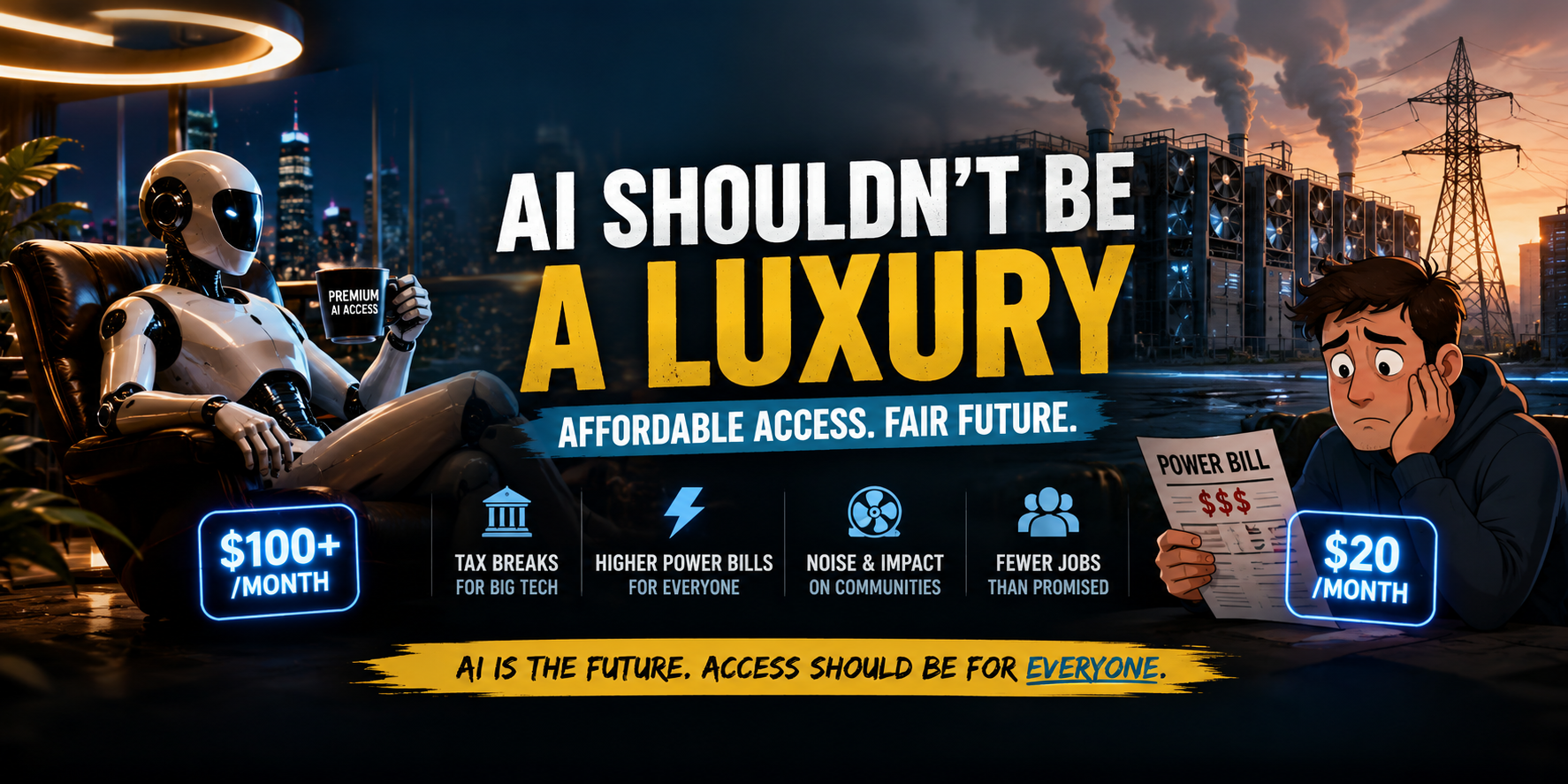

There is no question that artificial intelligence is the future. Whether we like it or not, AI is becoming part of everyday life. It is helping people write, create, learn, code, research, and solve problems faster than ever before. The technology is exciting, and in many ways it has the potential to improve all of our lives.
The problem is that the people building the future seem to be forgetting about the people who actually have to pay for it.
For years, many AI services followed a fairly reasonable model. You had a free tier to get started, and if you wanted more features, you could upgrade to a premium plan for around $20 a month. That wasn't exactly cheap, but it was within reach for a lot of normal people. Students, hobbyists, small business owners, retirees, and everyday users could usually justify the expense if they found enough value in it.
Now we're starting to see a growing trend where the next step up isn't $30 or $40 a month. Instead, it jumps straight to $100, $200, or even more. Recently, ChatGPT introduced new usage thresholds and premium options that continue pushing more advanced access into significantly higher-priced plans. The gap between the standard user and the power user is becoming a canyon.
Apparently there is no middle ground anymore.
It's a bit like going to a restaurant and being told you can either order from the value menu or buy the entire steakhouse.
The argument, of course, is that these AI systems are incredibly expensive to operate. Training models requires enormous computing power. Running them requires massive infrastructure. Fair enough. Nobody expects these companies to operate at a loss forever.
But that leads us to another interesting issue.
Many of these same companies are asking for tax incentives, subsidies, and special treatment to build gigantic data centers. We're told these projects are critical investments in the future. We're told they will drive innovation. We're told they will create economic growth.
What we're not always told is that many of these facilities don't create huge numbers of permanent jobs once construction is complete. A data center can represent billions of dollars in investment while employing far fewer people than many traditional industries.
Meanwhile, local communities are often left dealing with the side effects.
Power consumption is one of the biggest concerns. These facilities consume staggering amounts of electricity. Utility companies have openly discussed the challenges of meeting future demand created by large-scale AI infrastructure. In some areas, concerns are already being raised about how those costs may ultimately affect consumers.
Then there is the noise issue. Data centers aren't silent. Thousands of cooling fans, generators, and industrial equipment can create a constant hum that nearby residents have complained about in various communities. Nothing says "welcome to the future" quite like hearing what sounds like a jet engine in the distance while trying to enjoy your backyard.
So let's review.
The companies get tax incentives.
The companies build facilities that consume enormous amounts of power.
Communities deal with increased infrastructure demands.
Residents deal with noise concerns.
Electricity costs face upward pressure.
And then the people paying the bills are told that if they want better AI access, that'll be another hundred bucks a month.
It is hard not to notice a pattern.
The danger is that AI starts becoming another technology divide. The wealthy get access to the best tools, the highest limits, and the most advanced capabilities. Everyone else gets whatever remains behind increasingly restrictive usage caps.
That would be a mistake.
AI should not become a luxury item.
If this technology truly represents the future of education, productivity, creativity, and business, then access matters. The next generation of writers, artists, programmers, entrepreneurs, and students shouldn't be priced out simply because they cannot justify spending hundreds of dollars every month.
Nobody is arguing that AI companies shouldn't make money. They absolutely should. Building these systems is expensive and innovation deserves to be rewarded.
What many people are asking for is something much simpler.
Reasonable middle-ground pricing.
Give users a step between $20 and $100. Give small businesses, students, creators, and enthusiasts a path to grow without taking out a second mortgage. Make advanced AI accessible to more people instead of turning it into an exclusive club.
Because if AI really is the future, then the future should not be reserved only for those who can afford the VIP package.
The future should belong to everyone.
